Tag Archives: Covid

Unto us a Child is Born

Newborn, Nimule, South Sudan – Monica Corish

Unto us a Child is Born

On 25 August 2020, after four years without a single case, the African region was certified free of wild polio virus.

In 1994, a few days after I arrived in the border town of Nimule in South Sudan, I woke in the night to a bone-chilling cry. It reminded me of an Irish caoineadh, a keening for the dead. In the morning I heard that a baby had died of measles. I was stunned. I knew, from book-learning, that measles can damage the nerves, the eyes, the ears, the brain. I knew in my head that measles can be fatal, but in my heart I still thought of it as a benign childhood disease.

The epidemic raged through the small town, taking the children who were weak, malnourished, immuno-compromised. Night after night I heard the songs of grief – five children dead, still more facing lifelong disability – and then silence. The epidemic had burned itself out.

***

I was in Nimule to train community health workers, and to help with a programme of immunisation. With a team of South Sudanese and Kenyan health workers, I visited local villages and camps. Everywhere we went we offered immunisation against diphtheria, whooping cough, tetanus, measles, tuberculosis and polio.

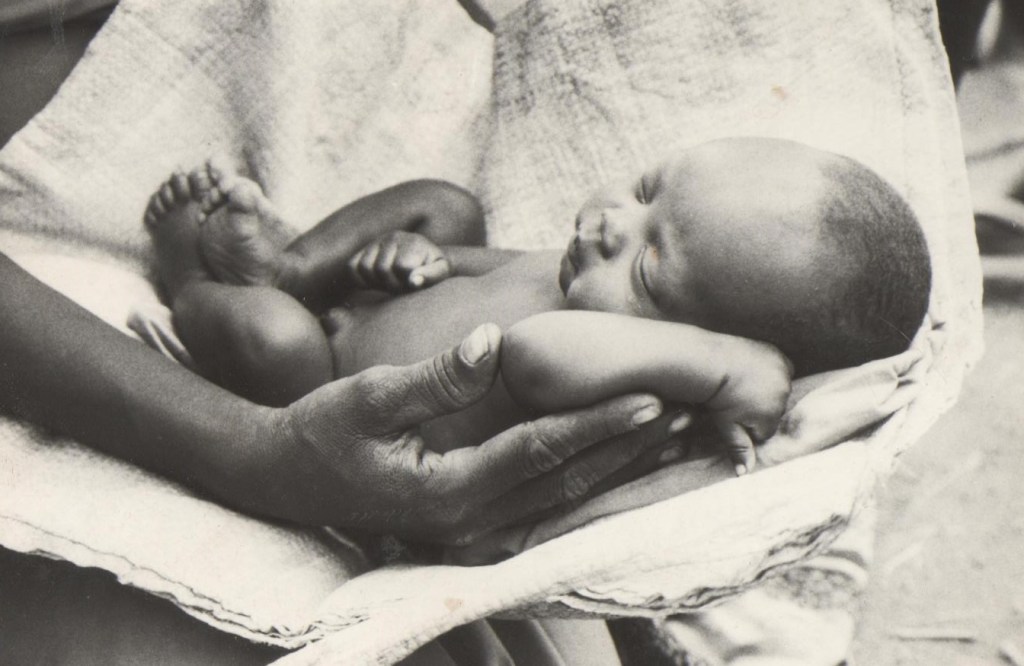
I met a young woman in one of the villages. She held her baby to her breast, in a wrap made out of a food sack. I asked how old her baby was. One week, she said. I asked if I could see. She unfolded the wrap and showed me her child. I can’t remember if it was a boy or a girl – I can’t remember the young woman’s name – I only remember her grace, her weathered hand holding her child, the newborn’s sleeping perfection. I asked the young woman if I could take a photograph of her baby. She said yes.

***

In 1994 an estimated 75,000 children across Africa were paralysed for life by the polio virus. Thousands of those children died when the virus paralysed their breathing muscles. Nelson Mandela, the recently elected president of South Africa, refused to accept this ongoing tragedy. “When people are determined,” he said, “they can overcome anything.” In 1996, in partnership with Rotary International, Mandela launched the “Kick Polio Out of Africa” campaign. Footballs with the slogan showed up everywhere – in stadiums, in school yards, on dusty soccer pitches. Communities, parents, health workers, volunteers, churches, mosques, governments, donors – they all came together, united by one aim – to immunise every child on the continent against this crippling disease.

***

On 25 August 2020, after four years without a single case, the 47 countries in the Africa region of the World Health Organisation were certified free of the wild polio virus. Today, because of the committed work of thousands of health workers and volunteers, more than 18 million people are able to walk, people who would otherwise have been paralysed by the virus.

But the fight against polio in Africa isn’t over yet. In Ireland, children are given an injectable vaccine that contains a dead form of the virus. This injectable form is expensive. Less well-off countries have to use an oral vaccine which contains an weakened form of the virus. In very rare circumstances this weakened virus can itself cause polio.

And so, although a huge milestone has been reached, immunisation and outbreak surveillance continue, and efforts are underway to make the injectable form of the virus available to everyone, everywhere. The journey continues, until the day when polio, like smallpox, is completely eradicated from the face of the earth.

***

That photo I took of the mother and her newborn has stayed with me over the years. I keep it close, on the door of my fridge, tucked into a diary, pinned to a corkboard.

I imagine this child grown to adulthood – I like that I don’t know whether it’s a girl or a boy – not knowing increases my sense of the possible lives this child may have led. I imagine that the infant in the photograph is a parent now, with children of their own. I imagine a baby, grandchild to the mother in the photograph, born into a world that is entirely free from the threat of polio.

***

This article 1st appeared in the Christmas 2020 issue of Africa Magazine. You can read more about the eradication of polio in Africa on these websites: www.africakicksoutwildpolio.com; Rotary International’s website www.endpolio.org; the Global Polio Eradication Initiative www.polioeradication.org; and GAVI, the Vaccine Alliance https://www.gavi.org

Mother and Newborn, Nimule, South Sudan – Monica Corish

In ár gcroíthe go deo / In our hearts forever: An art project to honour lives lost to Covid-19

A stunning art project, based in Carrick on Suir, described here by Margaret O’Brien, one of my Amherst Method writing colleagues. Heartbreaking and inspiring.

“I don’t know if I can take another Irish funeral,” whispered my English-born and -reared cousin, Nicholas… It was 2005… Now it’s 2020… How are you supposed to deal with the death of someone you love, someone you have cared for, in a time of a global pandemic, a period of national lockdown, with so many restrictions in place that the usual supports are kicked away from underneath you?”

Artist Tony Oakey, right, holding the original legacy art piece, with the late Mary Wells’ daughter Geraldine and family, and niece Martina. Geraldine is holding a copy of the print.

Writing Together in the Zoom Room – the pros and the cons

images

I’ve been leading Amherst Method writing groups since 2008 – in arts venues, in community centres, in my local library, and from the sitting room of my house in north Leitrim. In late March 2020, shortly after lockdown was announced, we left my sitting-room and entered into the Zoom-room.

The first few sessions were challenging. Together we learned a new and unfamiliar technology; we learned how to function as a group in a virtual space; we learned how to be spontaneous, while also being respectful of each other’s voices.

Some things stayed the same. As before, people gathered once a fortnight to write together in a safe and inspiring environment, based on the Amherst Method guidelines. At each session I offered a prompt and invited the group to write in response. Silence fell as words poured onto the page, for 10, 20, 30 minutes. If someone got stuck I could meet them one-to-one in a private “breakout room”, to help them find their flow again.

As before, I invited people to read what they had written; the group practiced the skill of “close listening” – a vital skill for every writer; and those who chose to read received positive feedback that helped them develop their voices. People wrote about everything under the sun in these sessions, including the minuscule virus that had upended our lives. One person wrote the first chapter of a witty Zoom-room murder mystery…

Sometimes a video connection broke down, sometimes the audio was glitchy – in rural Ireland strong broadband is a gift, not a given. The disadvantages of writing together online are obvious: you don’t get to meet your fellow participants in the flesh; you can’t read their body language or hear the small gasps of admiration as you read your work; you don’t get to chat one-to-one during the break.

But there are advantages. You can join in from anywhere in the world. And you don’t have to get into your car on a dark, blustery winter’s night to drive to my sitting-room in north Leitrim.

Writing prompt for the Crossing Borders Open-Mic: Interiors and Edges

The endlessly inventive and productive people at Across the Lines (IFI) / Open Mic Manor / The Thing Itself are inviting video or audio contributions for their next Crossing Borders Open Mic Online (IFI). The theme for this event is “Way-points and Markers” – the places, journeys and signposts that have marked our individual and collective transitions over the last three months.  They invited me to come up with a prompt to spark contributions. Here it is:

Hestia is the Greek goddess of interiors, of contemplative time and space. She is the hearth-fire that makes a house into a home.

Hermes is the trickster god of travel, trade, computers, protector of doorways and boundaries, the messenger and mover, the communicator.

In her books “Goddesses in Everywoman” and “Gods in Everyman”, Jean Shinoda Bolen tells how these two very different archetypes  are related. In Greek households the “herm” – a pillar symbolizing Hermes – stood just outside the front door, in a distinct but intimate connection with Hestia’s hearth-fire at the centre .

I invite you to see in your mind’s eye a place that represents the containment of “lockdown”; and a place that represents the process of “unlocking”. These places may be in the geography of your home, your county, your country, the world; or virtual places; or the space inside the arms of someone you love – a hug you are grateful to have received during lockdown, or a hug you are still yearning towards.

Whatever spaces come to you, feel them through your senses, through smell, and sight and touch and sound. And then write about these two spaces, placing them in relationship each with the other.

Image by Varun Kulkarni from Pixabay crop

Photo credits:


Writing Prompts from the Cocoon, June 2

This will be my last Writing Prompt from the Cocoon for a while – not because I am fully out of lockdown, but because summer is here and it’s time to concentrate on my own writing.

I leave you with another ekphrastic prompt, from this excellent Facebook page where members recreate famous works of art – in this case Кира Викторовна’s recreation of Salvador Dali’s 1925 work, “Girl at the Window“. You might write in response to either one of the images, or you might decide to place them in dialogue with each other.

Girl at the Window, after Dali

Two sources of prompts to keep you going over the summer:

  • Every week O Bhéal post a new five word poetry competition
  • The Poets and Writers website posts “a poetry prompt on Tuesdays, a fiction prompt on Wednesdays, and a creative nonfiction prompt on Thursdays”

Happy writing – stay well, stay safe, stay creative – Monica

Writing Prompts from the Cocoon, May 25

9360262_origA writing prompt to keep you going for a few weeks: Write a short story. How? There is plenty of advice on the Internet, some excellent, some less so. I chose the following from The Write Practice for one piece of advice that resonated: “Write your story in a single sitting”.

Here’s an abbreviated list of their suggestions:

  1. Read short stories…
  2. Write your story in a single sitting…  Everyone hates being interrupted when they’re telling a story. Use that to your advantage and don’t stop writing until you’ve finished…
  3. Read your draft… without changing anything. This will give you a sense of what work it needs…
  4. Write a premise… Get your head around the main idea behind your story by summarising your story in a one sentence premise. Your premise should contain three things: a character, a goal, and a situation.
  5. Write, edit, write, and edit. Good writing is rewriting. Use your second draft to fill in the plot holes and cut out the extraneous scenes and characters you discovered when you read the first draft in step #2. Then, polish up your final draft on the next round of edits.
  6. Submit!

Writing Prompts from the Cocoon, May 19

image from the new art of memory

Write a flash memoir. Start from the memory of a sound, a smell, a taste, a touch. Set yourself a 500-word limit – for me this is the equivalent of two handwritten A4 pages.
Before you begin consider the following advice from True Stories Well Told.
Flash Memoir tends to be:
  • Free of preambles—They start at the flashpoint—the moment when conflict ignites tangible action that drives the story forward.
  • Scene-based—They frequently take place in one run of time, without jumping around.
  • Observant—They tend to feature not the “I” but the “eye.”
  • Insightful—Like a flashlight illuminating a dark corner, they explore something that provoked an insight.
  • Specific—They stick with concrete, observable events and actions rather than abstract concepts.
  • True—As a subgenre of creative nonfiction, Flash Memoir must uphold the nonfiction contract that what is reported actually happened.
More advice from The Writer Mag :
  • At its most basic, a micro-memoir is written in sentences, drawn from personal experience, and strives to create a world in as few words as possible.
  • A true hybrid, the micro-memoir strives to combine the extreme abbreviation of poetry, the narrative tension of fiction, and the truth-telling of creative nonfiction…
  • What they’re not: fragments. Micro-memoirs aren’t slivers of a bigger creation. They’re designed to stand alone…
  • Forget about the big memories, like meeting your beloved or witnessing a tragedy.
  • Consider memories that you retain without understanding why.
And here are links to places where you might publish your flash memoir:


Image from page 80 of “The new art of memory, founded upon the principles taught by M. Gregor von Feinaigle: and applied to chronology, history, geography, languages, systematic tables, poetry, prose, and arithmetic.”

Image from page 80 of "The new art of memory, founded upon the principles taught by M. Gregor von Feinaigle: and applied to chronology, history, geography, languages, systematic tables, poetry, prose, and arithmetic. To which is added, some account of the

Writing Prompts from the Cocoon, May 12

Eavan_Boland_in_1996This week’s prompt is a quote from Eavan Boland, who died suddenly on April 27.

“I was aware,” she said, “that it was easier to have a political murder as the subject of an Irish poem than a baby or a washing machine.”

And as a bonus prompt, begin a piece of writing with the first line of The Pomegranate:

The only legend I have ever loved is…