Wordsmiths, Songwriters, Troubadours – I am delighted to be sharing the stage at the Glens as the guest of the multi-talented musician, singer and songwriter John Hoban, and the award-winning Irish-Peruvian poet Isabela Basombrío Hoban.
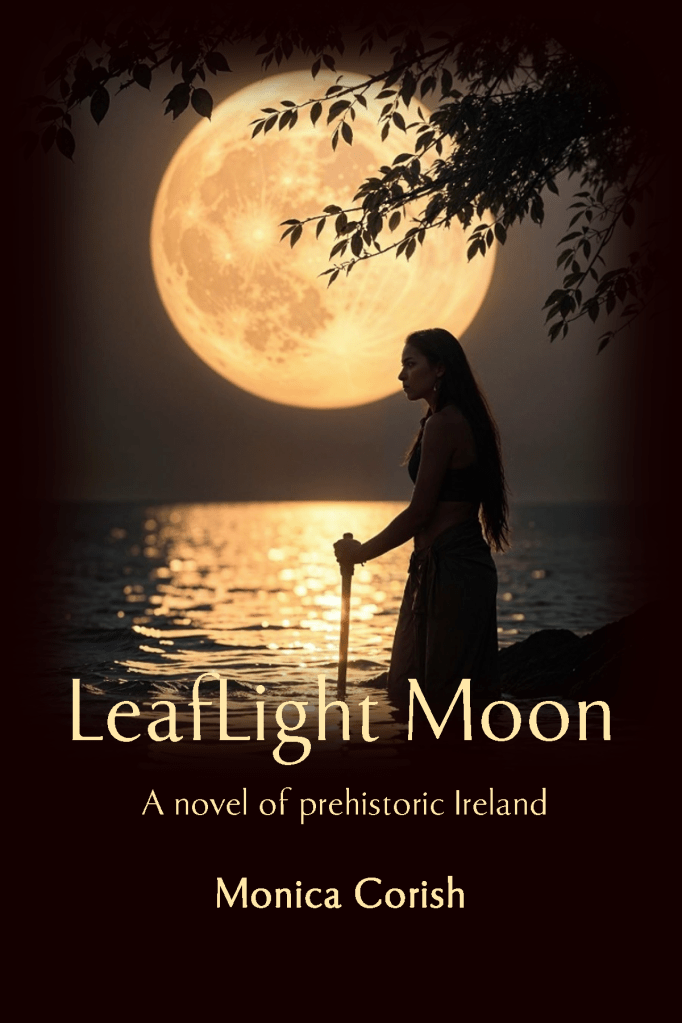
I will be reading from my award-winning novel “LeafLight Moon – a novel of prehistoric Ireland”, set in Sligo, North Leitrim, and a little bit of Tyrone, Fernamagh and Donegal…
Tom’s Pool of Darkness: Raymond Chandler in Ireland imagines a 1948 encounter between crime novelist Chandler and philosopher Wittgenstein in a remote corner of County Galway. As the two notoriously-reclusive men develop an unlikely friendship, they stumble into a conspiracy that involves former Nazis, the US House Un-American Activities Committee, and a cat belonging to the widow of William Butler Yeats. Theo Dorgan describes the book as “… a gem and a joy”…
LeafLight Moon – a novel of prehistoric Ireland will be launched by Susan O’Keeffe during Sligo’s Heritage Week. Closely researched and set 6000 years ago in the rich prehistoric landscapes of Sligo and the north-west, LeafLight Moon tells the story of the fateful encounter between Ireland’s first farmers and the hunter-gatherers of the Hearth of MotherMountain.
Did you watch From That Small Island on RTE? Were you tantalised by the brief mention of Ireland’s dark skinned, blue eyed hunter-gatherers? Want to know more?
“LeafLight Moon – a novel of prehistoric Ireland” will be released in August.
Closely researched and set in the rich prehistoric landscapes of Sligo and the North West, it tells the story of the fateful encounter between Ireland’s first farmers and the hunter-gatherers of the Hearth of MotherMountain.
I wrote this poem at an Ecopoetry workshop in the Glens Centre last August. My prompt was a line from Amanda Gorman’s poem Earthrise: “Floating like a silver raft in space… “
Thanks to Loretta Brennan of Africa Magazine for finding the marvellous image.
Alone, Together
It is possible that we are alone in all the quantum flip and spin, the quark and charm of the many-stanzaed universe, the beginning with no beginning, the grey entropic end.
It is possible that we are alone, we wrens and salamanders we spinning sycamore helicopters, we beluga and narwhal and fungi, we humans, entangled with apples and worms and plastic, with dark matter and black holes, with fracked shale and feral fires.
It is possible that we are alone, together, in all the sparkling riptide of stars.
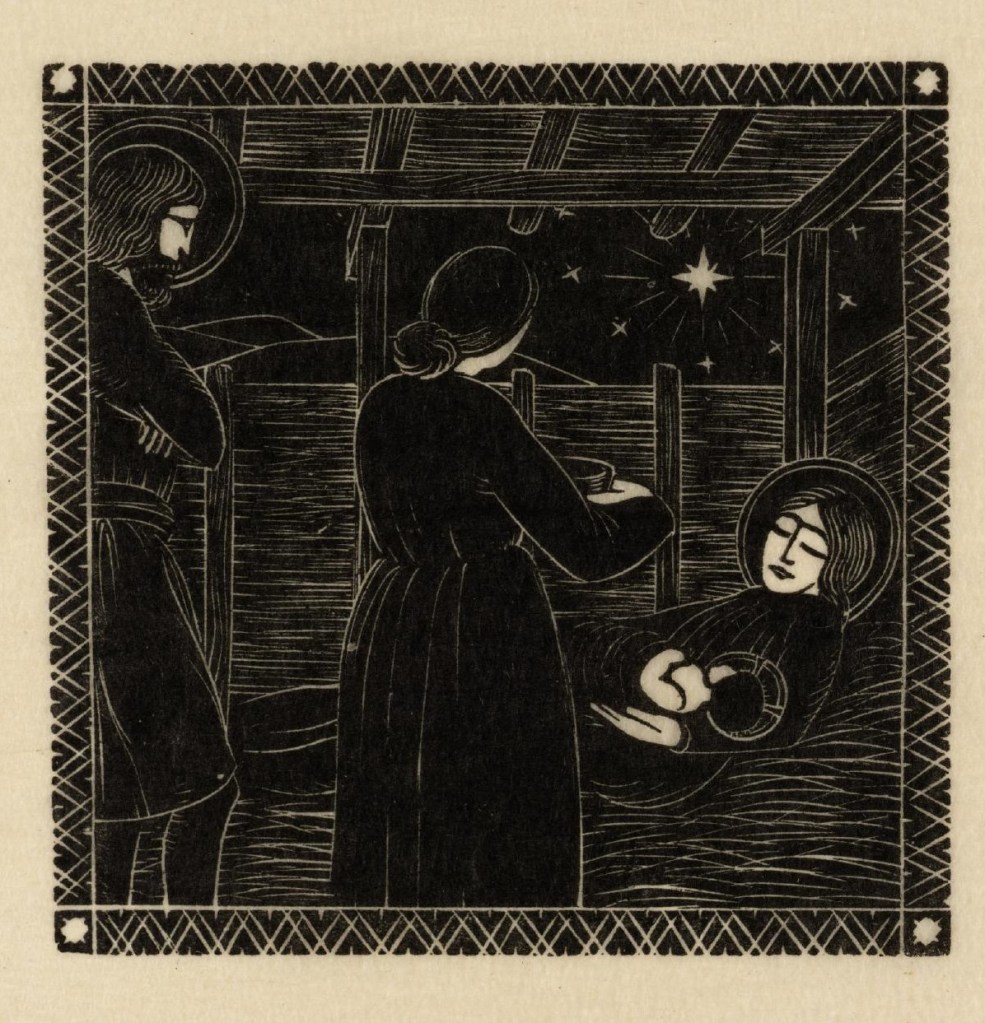
Brigid threw her eyes to heaven as the priest droned his way through the gospel. It’s as if he’s telling a dirge for a death, she thought, not an anthem for a birth and the best story of the year. But he’s a good man, gentle with the novices and their small sins, and not given to fawning over the pretty ones. Her mind drifted. Was it cold there, cold as this stone church on Christmas Eve? How did that poor frightened girl manage with only her old husband to help? The innkeeper’s wife would have been too busy – the shepherds knew how to deliver a lamb, they might have known been some help – but the angels waited until after the baby was born before they sang their Hosannas. Not a lick of sense between them. Why on earth didn’t Gabriel ask a midwife to be present for the birth?
The scraping of pews broke her reverie. She wrapped her green shawl close and took her place at the back, behind the line of monks and nuns. She noticed that Mother Muireann’s limp was getting worse, that Sister Imelda needed to mend her hem. She inched her way toward the altar, her breath fogging the chill air.
“Corpus Christi.”
The host dissolved on her tongue. She bowed her head and prayed, her body suffused with the light of God incarnate. Her slave-born mother’s words flashed through her mind. You have the spirit of a nun, Brigid, and the soul of a poet, and the hands of a skilful midwife. As the choir sang the recessional hymn, she fizzed with fear and excitement. Can it be done? Could I do it?
*
When the abbey was fast asleep, Brigid rose from her bed. The Chapel of the Flame reminded her, as it always did, of a small child nestled beneath the protection of the great winter oak. She laid one hand on fissured bark, one hand on lichened stone, breathing deep, asking for courage. Then she lifted the latch and opened the door. Áine was dozing on a bench at the far side of the fire.
“Sister Áine.”
The young nun snapped awake. “Mother Brigid!”
“I will tend the flame tonight. You may go to your bed.”
*
She gazed into the leaping flames, seeing again the old woman, the one who had tended the flame before the coming of the Christ-story. They shared the same name, Brigid, woman of valour. The old Brigid had been the last of her kind, the seer-women who communed with the goddesses and gods of old Ireland. She remembered her words: This flame sits over the eye of a holy well. It is a marriage of sacred water and sacred fire. It will not burn your flesh. This flame is a doorway into the time before, and a doorway into the time that is to come. If your intention is pure, this flame will take you where you need to go. She had never, in all her years as abbess, tested the truth of the old Brigid’s story. Because, she thought, I am still wary of the pagan mysteries, I worry that their power might seduce me away from the Christ-story. But now, tonight, my intention is pure – none purer – to serve the Mother of God. She thrust her hand in, whipped it out. The small hairs on the back of her fingers had not been singed. She reached in again, felt a liquid coolness. She stared at the drops of dew in her palm.
Do it now, she told herself, before your courage fails. She cleared a level space in the centre of the fire with the poker, then closed her eyes. With her inner eye she saw where she needed to go – the stable – the ox and the ass – the young woman, her belly huge with child – the old man Joseph – the guiding star.
She stepped in.
She was standing in the middle of a forked tree, three splayed trunks fanning out, one bent low to touch the ground. Between her feet, between the sister-trunks, she found the small un-burning flame, her pathway home. She sighed with relief. A drunk sang a tuneless song, someone shouted at him to shush. She became aware of the bustle of the inn – the star – the lamp-lit stable.
She stepped out from between the tree-trunks and walked across the sandy ground. Through the open doorway she saw Mary and Joseph, the young woman’s face knotted with pain, the old man’s face racked with fear. She knocked on the lintel.
“Greetings,” she said. “I am Brigid of Ireland. I have come to be midwife at the birth of your child.”
The Colour Red Has Many Flavours is a potent story of realization. In this epiphanic moment, a woman in an abusive relationship recognizes what she’s been living in, as if waking up from a terrible dream. The way the story builds makes us see, through the main character’s perspective, just how unhappy she has become. Earned through the careful crafting of language and world building, the author brings realistic and often shocking insight. This insight comes from the sort of questioning that ensues when something bleak is transformed by a moment of brightness or when something seemingly mundane is suddenly revealed as earth-shattering. Because the story is loaded with masterful use of sensory detail, and the reader is treated to a most satisfying ending—something we wish happened more often in the real world.
On 25 August 2020, after four years without a single case, the African region was certified free of wild polio virus.
In 1994, a few days after I arrived in the border town of Nimule in South Sudan, I woke in the night to a bone-chilling cry. It reminded me of an Irish caoineadh, a keening for the dead. In the morning I heard that a baby had died of measles. I was stunned. I knew, from book-learning, that measles can damage the nerves, the eyes, the ears, the brain. I knew in my head that measles can be fatal, but in my heart I still thought of it as a benign childhood disease.
The epidemic raged through the small town, taking the children who were weak, malnourished, immuno-compromised. Night after night I heard the songs of grief – five children dead, still more facing lifelong disability – and then silence. The epidemic had burned itself out.
***
I was in Nimule to train community health workers, and to help with a programme of immunisation. With a team of South Sudanese and Kenyan health workers, I visited local villages and camps. Everywhere we went we offered immunisation against diphtheria, whooping cough, tetanus, measles, tuberculosis and polio.
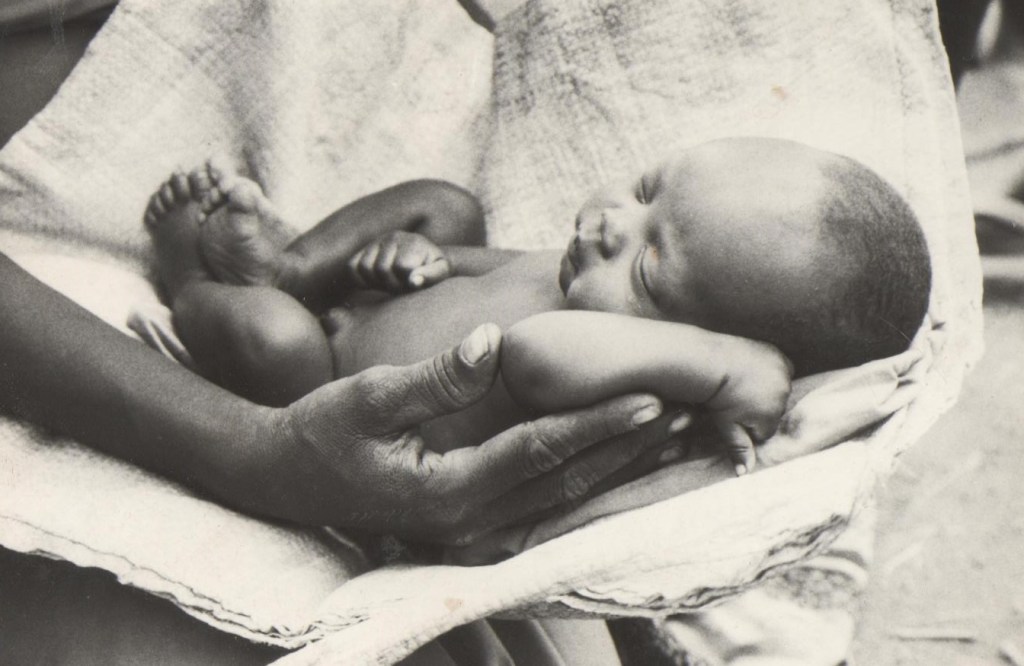
I met a young woman in one of the villages. She held her baby to her breast, in a wrap made out of a food sack. I asked how old her baby was. One week, she said. I asked if I could see. She unfolded the wrap and showed me her child. I can’t remember if it was a boy or a girl – I can’t remember the young woman’s name – I only remember her grace, her weathered hand holding her child, the newborn’s sleeping perfection. I asked the young woman if I could take a photograph of her baby. She said yes.
***
In 1994 an estimated 75,000 children across Africa were paralysed for life by the polio virus. Thousands of those children died when the virus paralysed their breathing muscles. Nelson Mandela, the recently elected president of South Africa, refused to accept this ongoing tragedy. “When people are determined,” he said, “they can overcome anything.” In 1996, in partnership with Rotary International, Mandela launched the “Kick Polio Out of Africa” campaign. Footballs with the slogan showed up everywhere – in stadiums, in school yards, on dusty soccer pitches. Communities, parents, health workers, volunteers, churches, mosques, governments, donors – they all came together, united by one aim – to immunise every child on the continent against this crippling disease.
***
On 25 August 2020, after four years without a single case, the 47 countries in the Africa region of the World Health Organisation were certified free of the wild polio virus. Today, because of the committed work of thousands of health workers and volunteers, more than 18 million people are able to walk, people who would otherwise have been paralysed by the virus.
But the fight against polio in Africa isn’t over yet. In Ireland, children are given an injectable vaccine that contains a dead form of the virus. This injectable form is expensive. Less well-off countries have to use an oral vaccine which contains an weakened form of the virus. In very rare circumstances this weakened virus can itself cause polio.
And so, although a huge milestone has been reached, immunisation and outbreak surveillance continue, and efforts are underway to make the injectable form of the virus available to everyone, everywhere. The journey continues, until the day when polio, like smallpox, is completely eradicated from the face of the earth.
***
That photo I took of the mother and her newborn has stayed with me over the years. I keep it close, on the door of my fridge, tucked into a diary, pinned to a corkboard.
I imagine this child grown to adulthood – I like that I don’t know whether it’s a girl or a boy – not knowing increases my sense of the possible lives this child may have led. I imagine that the infant in the photograph is a parent now, with children of their own. I imagine a baby, grandchild to the mother in the photograph, born into a world that is entirely free from the threat of polio.
Delighted to have my poems – and video of Maeve’s Version – published in “Trasna“, an online journal out of Lowell, Massachusetts edited by Christine O’Connor, Margaret O’Brien and Jeannie Judge.







 Monica Corish